I Say DWP Could Owe Me £91,065 More: The Tribunal Errors Now Being Reviewed in McRobbie v DWP (not including the two Claims in the Employment Appeals Court)
I say the Department for Work and Pensions could owe me a further £91,065.34 if the Tribunal corrects the errors I have identified in the remedy and costs judgment in my Employment Tribunal case.
That is not a figure plucked from thin air.
It is based on the Tribunal’s own figures, the Tribunal’s own wording, and the Tribunal’s own finding that disability trigger points were never formally adjusted for me in respect of either my physical disability or my mental health disability.
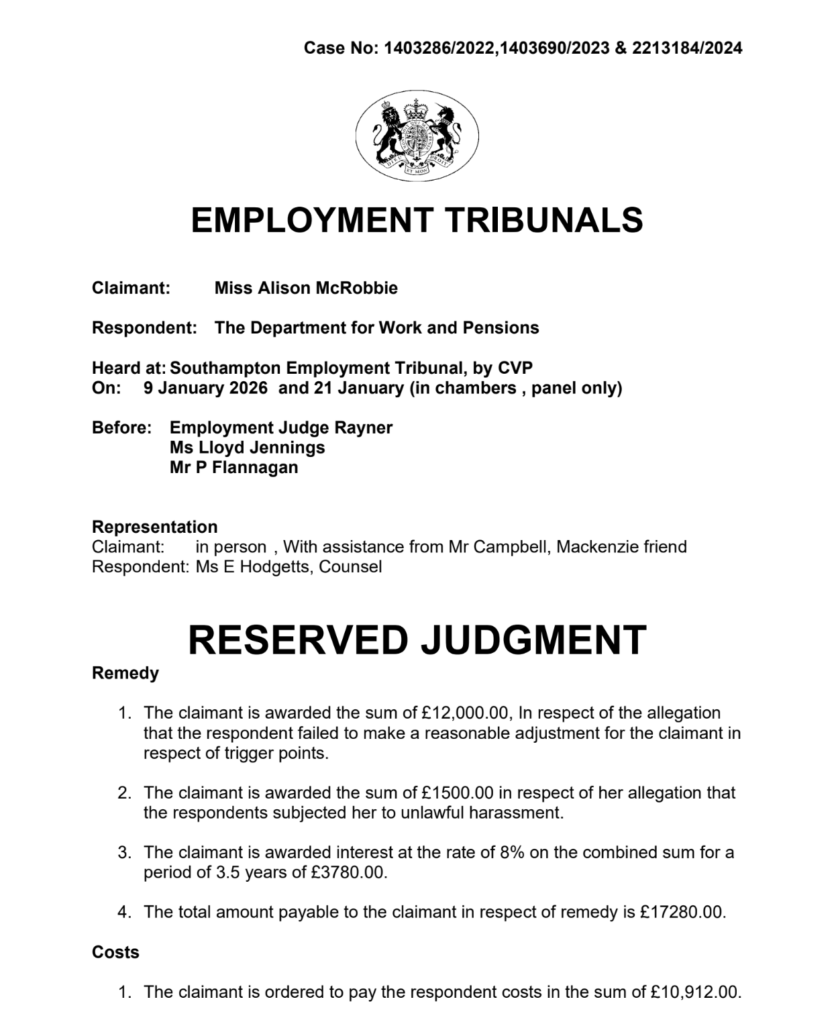
The judgment currently says I was awarded £17,280 after findings of disability discrimination and harassment.
However, the same judgment also ordered me to pay the DWP £10,912 in costs for requesting to strike out DWP’s Defense when DWP didn’t comply with an order of the court!
That means that, in practical terms, most of the compensation awarded to me for proven unlawful conduct has been swallowed up by a disputed costs order. How convenient. What’s even more Convenient, is that the same Employment Tribunal who issued this judgement on the 1st May 2026, have ignored my emails on the 14th May, June17th and June 23rd, requesting a review of the errors under Rule 69 and rule 70.
I have now asked the Tribunal to correct and/or reconsider the judgment.
After calling the Tribunal, I have been told the matter is now being looked at.
The £91,065.34 figure
Let me explain the calculation.
The Tribunal awarded me £12,000 for DWP’s failure to make reasonable adjustments concerning disability trigger points.
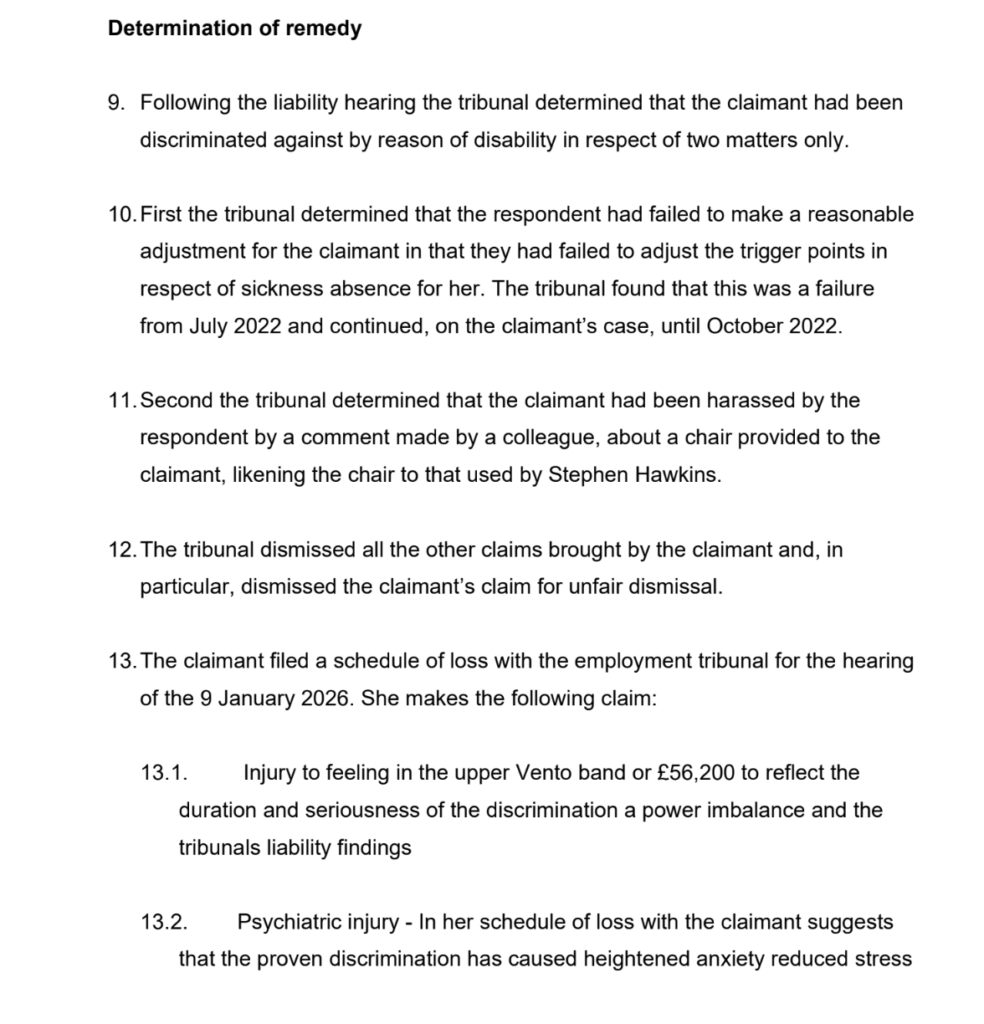
The remedy judgment appears to treat that failure as lasting approximately four months, from July 2022 to October 2022.
That creates an implied value of:
£12,000 ÷ 4 months = £3,000 per month
But the liability judgment says something much wider.
It found that:
“The Claimant is right that trigger points were never formally adjusted for her in respect of either a physical disability or a mental health disability.”
My position is that this was not a four-month failure. It continued throughout my employment, for approximately 30 months.
Using the Tribunal’s own implied valuation:
£3,000 × 30 months = £90,000
Then add the harassment award:
£90,000 + £1,500 = £91,500
The Tribunal applied interest at 8% for 3.5 years, which is 28%.
So:
£91,500 × 28% = £25,620 interest
That gives a corrected alternative remedy figure of:
£91,500 + £25,620 = £117,120
The costs figure also appears to be wrong.
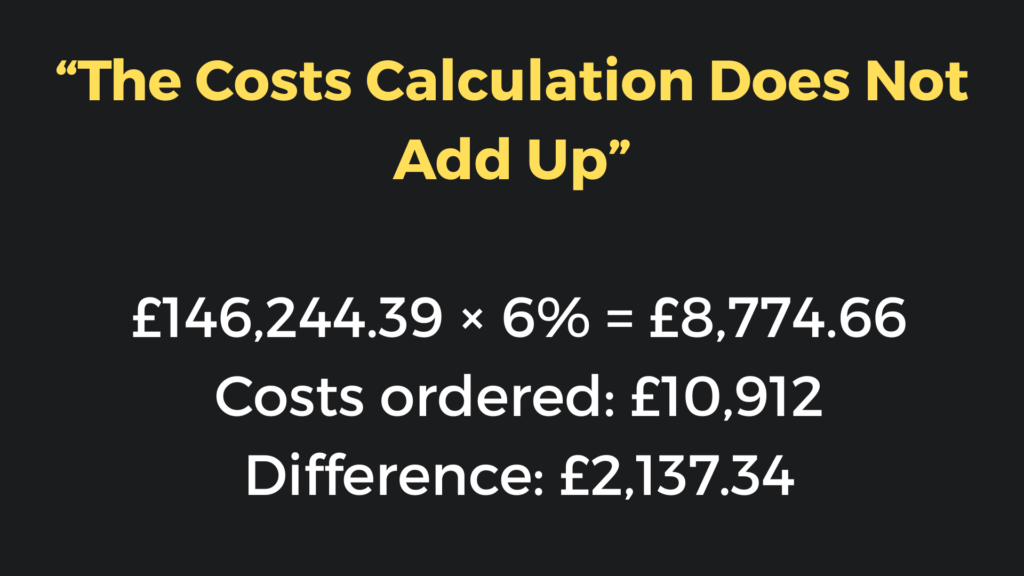
The judgment records total stated costs of £146,244.39 and says the Tribunal considered “about 6% of the total costs” appropriate.
Six percent of £146,244.39 is:
£8,774.66
But the costs order made against me was:
£10,912
That is a difference of:
£2,137.34
If the corrected costs figure of £8,774.66 is deducted from the corrected remedy figure of £117,120, the corrected net position would be:
£117,120 – £8,774.66 = £108,345.34
The DWP has already paid me £17,280.
So the further net amount due to me on my alternative corrected calculation would be:
£108,345.34 – £17,280 = £91,065.34
That is why I say DWP could owe me a further £91,065.34 if the Tribunal corrects the errors I have identified.
I am not saying injury-to-feelings awards are always calculated monthly
To be clear, I understand that injury-to-feelings awards are not always calculated mechanically on a monthly basis.
But that is not the point.
The point is that the Tribunal appears to have assessed remedy on the basis of a short four-month failure, while the liability judgment found that trigger points were never formally adjusted for me.
That is a material inconsistency.
If the Tribunal’s own judgment says disability trigger points were never formally adjusted, then the remedy judgment needs to explain why compensation was assessed as though the failure only lasted from July 2022 to October 2022.
The trigger point error matters
This case was not just about a workplace technicality.
It was about disability, sickness absence, mental health, reasonable adjustments and the stress of being placed under attendance management when disability-related absences were not properly considered.
At paragraph 480 of the liability judgment, the Tribunal found that it would have been appropriate for DWP to specifically ask Occupational Health to consider whether I was disabled by reason of a physical or mental impairment and whether adjustments should be made to the trigger points.
The Tribunal expressly found:
“This did not happen.”
At paragraph 488, the Tribunal found:
“The Claimant is right that trigger points were never formally adjusted for her in respect of either a physical disability or a mental health disability.”
The liability judgment also recorded the issue as:
“Failing to calculate or apply Disability Trigger Points to the Claimant, despite her requests to her managers, Mr McCarten, Ms Nye, Mr Fardell, Mr Rogers and Ms Downing, that they do so.”
The Tribunal also found that the failure to determine trigger points caused me distress.
These are not findings of a short, isolated four-month failure.
They are findings that disability trigger points were never formally adjusted, that Occupational Health was not properly asked to consider them, that management failed to determine them, and that I raised the matter with multiple managers.
That is why I have asked the Tribunal to reconsider and/or clarify why the remedy judgment limited the failure to July 2022 to October 2022.

The costs calculation does not appear to add up
There is also a separate issue with the costs order.
The Tribunal recorded:
Counsel’s costs: £42,597.00
Solicitors’ costs: £103,647.39
Total stated costs: £146,244.39
The Tribunal then said that a sum equivalent to “about 6% of the total costs” would be appropriate.
But the order made was £10,912.
Six percent of £146,244.39 is £8,774.66, not £10,912.
The order appears to represent approximately 7.46% of the stated total costs, not 6%.
That is not a small rounding issue.
It is a material difference of £2,137.34 against a disabled litigant in person.
I have asked the Tribunal to consider this as an apparent clerical, arithmetic or accidental error.
Until the apparent costs calculation issue has been corrected or formally determined, I do not accept that I should be expected to pay the disputed costs figure.
I also do not accept that any interest, enforcement charges, additional costs or adverse consequences should be attributed to me while the calculation remains unresolved and while my reconsideration/correction request remains unanswered.
The case was marked closed despite my in-time reconsideration
The remedy and costs judgment was sent to the parties on 1 May 2026.
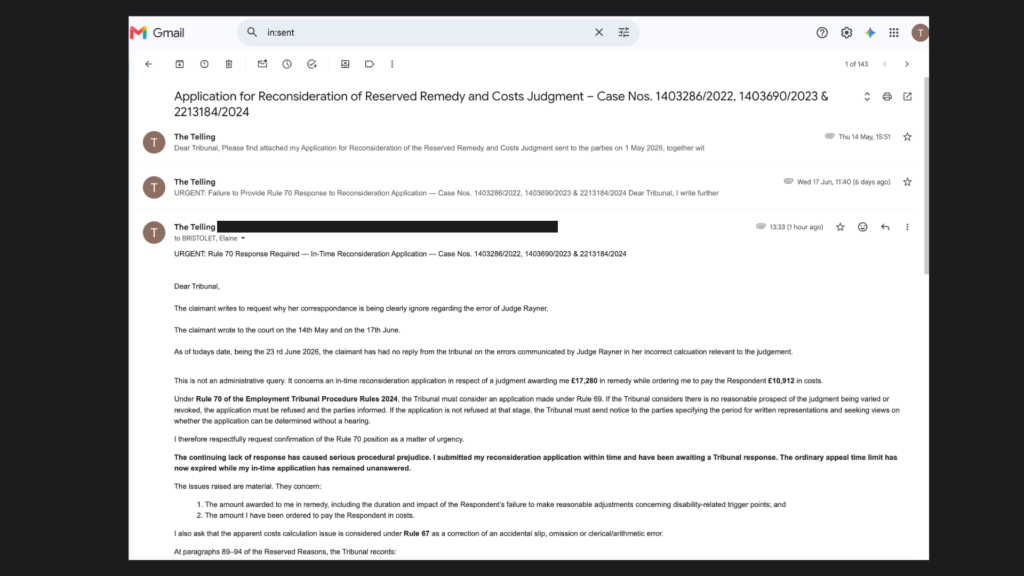
I submitted my reconsideration application on 14 May 2026.
I chased the Tribunal again on 17 June 2026.
I then called the Tribunal and was told the case had been marked closed.
That is deeply concerning.
An administrative closure is not the same as a decision on an in-time reconsideration application.
I have now asked the Tribunal to confirm what happened to my application, whether it was placed before the Judge or panel, and whether the apparent calculation issue will be dealt with under the correction process.
Following my call, I have been told the matter is now being looked at.
But why does it take me to call and call a tribunal, for a Tribunal to follow the legal process they are mandated to follow!
I’m a disabled, litigant in person and I feel, I am given the real System run-around, some may say, its being done intentionally!
The fraud-team evidence and dismissal finding
There is also a serious issue in the liability judgment concerning the Tribunal’s treatment of evidence relating to DWP’s Counter Fraud and Compliance Directorate.
At paragraph 974, the Tribunal stated that, despite being given every opportunity, I was unable to find evidence suggesting that I had ever been involved with any fraud project, or that this explained my access to the CIS reports.
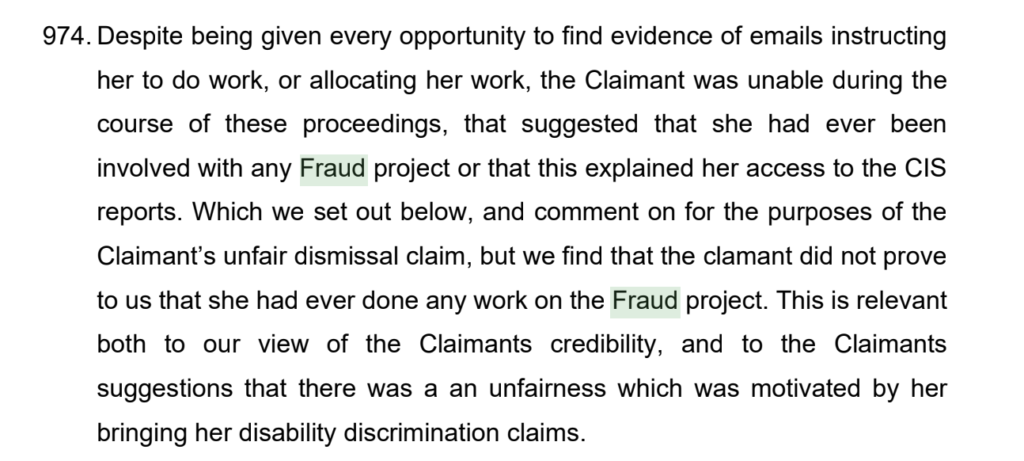
The Tribunal then stated that I had not proved that I had ever done work on the fraud project, and said this was relevant both to its view of my credibility and to my case that there was unfairness connected to my disability discrimination claims.
I dispute that finding.
My position is that there was evidence before the Tribunal, including an email from DWP’s Counter Fraud and Compliance Directorate.
That email referred to the “SE GWI closed case test”, stated that the sender “did the case check for Compliance”, explained that “the project would be sourcing a Work Coach”, and said that a colleague who had taken over the area of work as Lead had asked him to contact me “to progress.”
The email also referred to arranging a call to discuss “next steps for the cases.”
My position is that this was plainly relevant evidence.
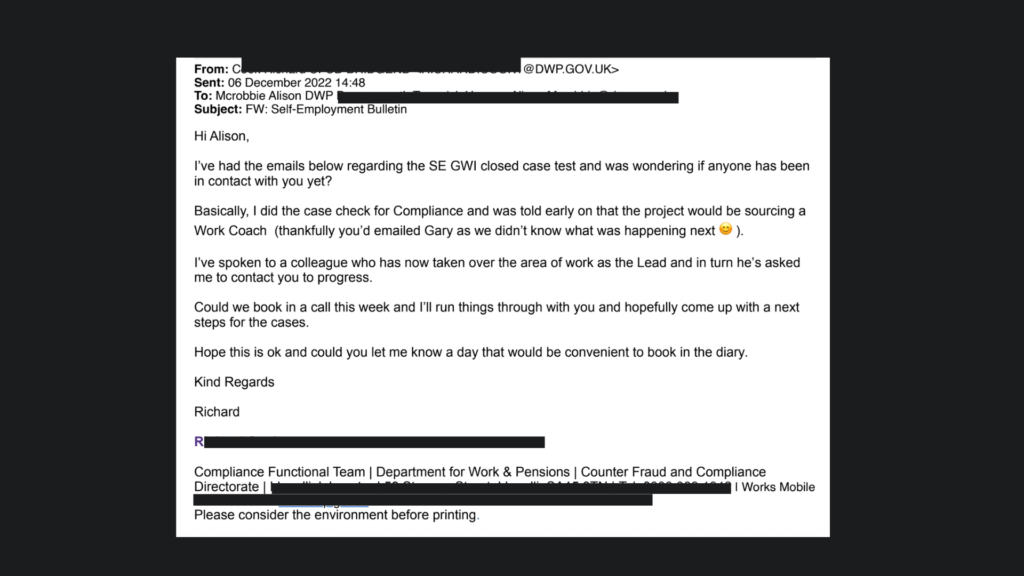
It did not have to prove every aspect of my case in isolation. But it did show contact from DWP Counter Fraud and Compliance Directorate about a self-employment/compliance case-check project involving a Work Coach and next steps for cases.
The Tribunal’s paragraph 974 finding was not minor.
The Tribunal expressly said it affected its view of my credibility and my arguments about unfairness.
That matters.
If material evidence of this kind was before the Tribunal but was not properly considered or engaged with, then I say that is a material error.
I also say the wrong legal approach was applied to the dismissal issue
I also say the Tribunal applied the wrong legal approach to the dismissal issue.
In an unfair dismissal case, the question is not simply whether the Tribunal itself thinks the employee proved or disproved something.
The proper question is whether the employer had a fair reason for dismissal, whether the employer had a genuine and reasonable belief based on a reasonable investigation at the time, and whether dismissal fell within the range of reasonable responses open to a reasonable employer.
My position is that the Tribunal effectively treated parts of the dismissal issue as though I had to prove the fraud-project work to the Tribunal’s satisfaction, rather than properly asking whether DWP’s investigation and dismissal decision were reasonable.
That is a serious distinction. Especially considering the dubious, unverifed print out by DWP, that had mismatches of dates, font sizes and the massive flaw in their evidence was alledging two claims can be logged into at the same time on one user card – they cannot.
The tribunal also refused to accept a live stream on TikTok by myself, on the beach at the same time of the alleged incident which DWP say was the reason for dismissal.
If the Tribunal failed to properly engage with evidence that undermined the dismissal narrative, then that affects credibility, fairness and the overall safety of the dismissal finding.
Why this matters publicly
Some media articles have reported that I have been ordered to pay costs to the DWP.
What has not been made clear is that I am disputing the costs order and have submitted an in-time reconsideration and correction request. I already have two appeals that have been accepted by the Appeals court surrounding dismissal and other important elements that I say DWP, were permitted by the t to cherry pick away from the case.
I am not trying to hide the fact that a costs order was made.
I am saying that the order is materially disputed and that the Tribunal has not yet corrected or determined the issues I have raised. They are obliged by law to respond to matters surronding law just as it anyone else.
That distinction matters.
It is unfair for a disputed costs order to be treated publicly as final and unchallenged when I have raised an apparent calculation error and an inconsistency in the remedy judgment.
It is also unfair for the public story to become “Alison McRobbie has to pay DWP costs” without explaining that I won findings of disability discrimination and harassment, was awarded compensation, and am now challenging the way the remedy and costs judgment has been calculated and reasoned.
There is a wider issue here about how disabled litigants in person are treated when they challenge public authorities.
A disabled person can be honest, capable, organised and still be disbelieved. A disabled employee can raise legitimate concerns and still be painted as difficult. A litigant in person can point to evidence and still be told, in effect, that they have not proved what is already sitting in the papers.
That is why these judgments matter.
My question is simple: who checks the accuracy of findings like this when they have such serious financial and reputational consequences?
Employment Judge Catherine Rayner is an experienced employment judge and barrister. I consider it reasonable to expect that a remedy and costs judgment involving disability discrimination, harassment, compensation and a substantial costs order should contain accurate calculations and clear reasoning.
But on the face of the judgment, the costs calculation does not appear to match the Tribunal’s own wording. The Tribunal refers to “about 6% of the total costs” but orders a figure which appears to be around 7.46% of the stated total costs. That is a difference of £2,137.34.
So the question is not personal. The question is procedural and factual:
Was this a clerical or arithmetic error?
Was a different percentage actually intended?
Or has the costs figure been applied in a way that the judgment does not properly explain?
Either way, I say it needs to be corrected or formally clarified, because both figures cannot be right.
What I am asking the Tribunal to do
I have asked the Tribunal to confirm:
Whether my 14 May reconsideration application was received.
Whether my 17 June chase was received.
Whether the application was placed before the Judge or panel.
Whether the Tribunal has considered the application under the reconsideration rules.
Whether the apparent costs calculation issue has been considered as a correction.
Whether enforcement of the costs order is stayed while these issues remain unresolved.
I have also asked the Tribunal to reconsider and/or clarify why the remedy judgment limited the disability trigger-point failure to July 2022 to October 2022, when the liability judgment records that trigger points were never formally adjusted for me.
This is about accountability
This case was about disability, reasonable adjustments, harassment, and how a public body treated a disabled employee.
The Tribunal found that DWP failed to make reasonable adjustments in relation to disability trigger points.
The Tribunal found that I was subjected to unlawful harassment.
But a remedy judgment must still be accurate.
A costs order must still add up.
A disabled litigant in person should not be left waiting in silence after making an in-time reconsideration application.
A finding affecting credibility should not ignore material evidence.
A judgment should not publicly reduce a discrimination award through a disputed costs order while apparent calculation errors and unresolved reconsideration issues remain unanswered.
I will continue to update this page as the Tribunal responds.
For now, my position is simple:
I say DWP could owe me a further £91,065.34 on my alternative corrected calculation.
The costs order is disputed.
The remedy judgment contains apparent material errors.
The reconsideration application was submitted in time.
The Tribunal has now been asked to look at it again.
And I am reviewing appeal grounds concerning the remedy, costs and dismissal findings.

Why I Created OFFSYSTEM
I created OFFSYSTEM because I know what it feels like to be inside a system that can make disabled people feel powerless, disbelieved and financially trapped.
Often you are literally gaslight with your own disability from organisations that are meant to exist to protect – not deflect.
I am a fierce campaigner for disability advocacy, self-employment and helping disabled, chronically ill and health-impacted people live with more independence, more evidence and more options.
For many disabled people, work does not always look like a traditional 9–5 job.
Sometimes independence means building a small business from home. Sometimes it means creating flexible income around your health. Sometimes it means using your lived experience, skills, knowledge or creativity to create something that belongs to you.
And many people do not realise that Access to Work can support disabled people who are in work, about to start work, or self-employed. Access to Work can help with support that enables someone to stay in work or self-employment, depending on their circumstances. It is not a magic wand, and it is not automatic, but for the right person it can be part of building a more supported working life.
OFFSYSTEM is the official membership from The Justice Journals. It gives members access to practical resources, templates, live support, MONEYSAFE™, JusticeWriter Pro®, disability evidence tools, PIP resources, self-employment guidance and support with the paperwork and processes that can affect their lives.
This is not about scaremongering.
It is about preparation.
It is about income.
It is about evidence.
It is about understanding your options.
And it is about helping people build a life that is not entirely dependent on a system I believe fails too many disabled people as my own case, undeniably proves.