“Yes I had 10 points but then 0 at review.”
This comment stopped me in my tracks and here is how you make sure it doesn’t stop you.
If you live with a disability or long-term health condition, it is okay to admit that proving it is exhausting.
You are already living with the pain, fatigue, anxiety, mobility problems, brain fog, flare-ups or recovery time.
You should not also have to spend your life preparing for the day someone asks:
“Where is your evidence?”
But this is the reality far too many people are facing.
One person commented on my channel that she had 10 PIP points — and after her review, she was given zero.
Another person with multiple sclerosis said that one day she may be able to shuffle around, and the next day her legs simply will not cooperate.
That is the fluctuation trap.
A decision-maker sees one appointment.
One form.
One “better” day.
One moment where you managed something.
You live the other 364 days.
And this is why your evidence matters.
Not because your condition is not real unless it is written down.
But because when your claim, support, adjustments or rights are questioned, a clear written record can show the part of your life that a snapshot assessment never sees.
Here are 25 things I believe people with fluctuating disabilities should start recording:
Step 1: Write down the condition or symptoms affecting you that day.
Step 2: Record whether it was a better day, typical day, bad day or flare-up day.
Step 3: Note your pain, fatigue, anxiety, overwhelm or mobility level.
Step 4: Record what you planned to do that day.
Step 5: Write down what you could not do.
Step 6: Record any activity you attempted but could not finish.
Step 7: Note whether you needed help, prompting, supervision or an aid.
Step 8: Record if preparing food was unsafe, painful or impossible.
Step 9: Note if washing, dressing or managing medication was affected.
Step 10: Record if you could not leave the house.
Step 11: Record how far you could actually walk — not how far you wished you could.
Step 12: Note whether you had to stop, sit, rest or recover.
Step 13: Record falls, near-falls, dizziness, panic or accidents.
Step 14: Note if an activity took much longer than it would take someone without your condition.
Step 15: Record if you managed something once but could not repeat it.
Step 16: Write down what happened afterwards.
Step 17: Record recovery time after appointments, shopping, walking or household tasks.
Step 18: Note if you cancelled plans or relied on somebody else.
Step 19: Record medication changes, side effects and treatments.
Step 20: Keep a log of GP appointments, hospital visits and referrals.
Step 21: Record the days when your symptoms fluctuate unexpectedly.
Step 22: Note what a “good day” actually means for you — because a good day may still involve serious limitation.
Step 23: Record what happens on most days, not only your very worst day.
Step 24: Keep supporting documents together rather than searching for them when you are already under pressure.
Step 25: Do not wait until a review, reassessment, appeal or workplace dispute to start building the record.
Because the hardest time to prove the impact of six months of illness is when you are already frightened, overwhelmed and up against a deadline.
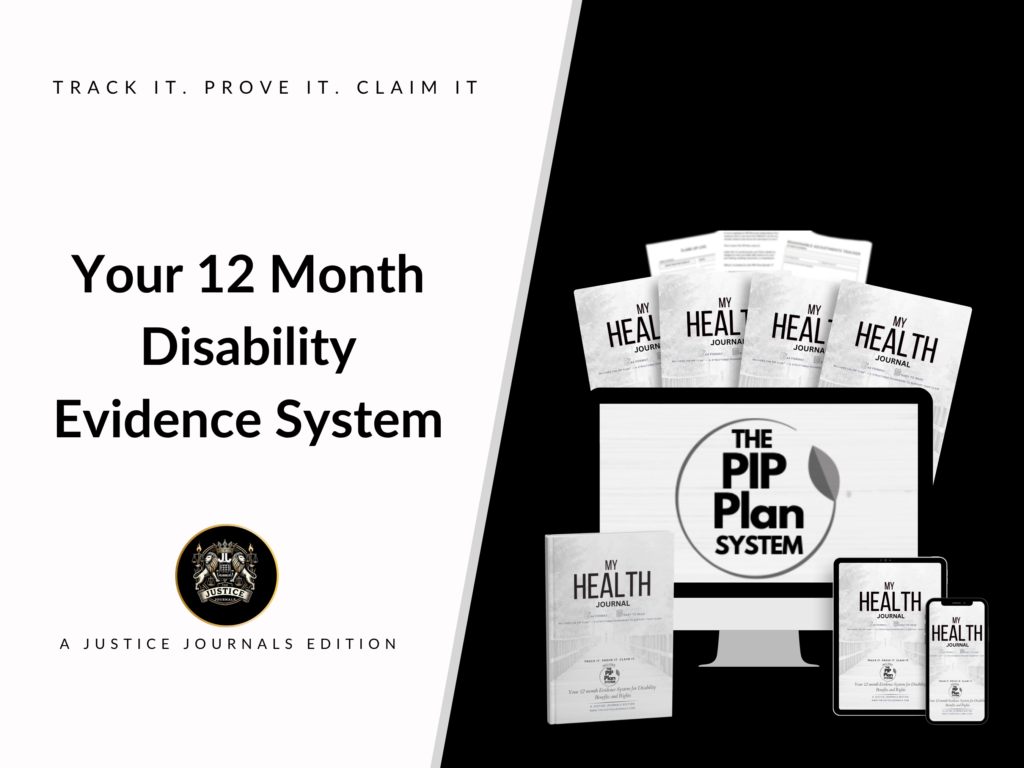
This is exactly why I created PROVE IT.
PROVE IT is designed to help you understand how to build a clearer evidence trail around disability impact, fluctuating conditions, daily difficulties and the reality behind the paperwork.
It is for people who are applying for PIP, facing a review, worried their evidence is not being properly understood, or dealing with situations where their health impact may be questioned.
It is not about exaggerating.
It is not about saying the “right” thing.
It is about making sure your real life is not reduced to one appointment, one form or one person’s assumption about what you can manage.
Because when someone later says:
“You seemed fine.”
“You managed that one task.”
“You attended an appointment.”
“You looked well.”
“You have not provided enough evidence.”
You deserve to have a record that says:
This is what my life actually looks like.
A PIP enhanced daily living award is currently worth hundreds of pounds every month. Workplace disability disputes can affect your income, health and future. PROVE IT is a one-off investment in understanding how to build the evidence record you may one day need.

The Financial Difference Between Standard and Enhanced Rate PIP
It is important to say this clearly: no planner, course or evidence resource can guarantee a PIP award or an enhanced rate decision.
PIP is awarded according to how your disability or health condition affects specific daily living and mobility activities. To qualify for enhanced rate, your evidence must support the relevant descriptors and you must score at least 12 points for that component.
But where somebody genuinely meets the enhanced rate criteria, the financial difference between their needs being properly understood and their needs being underestimated can be significant.
For 2026/27, the weekly PIP rates are:
| PIP Component | Standard Weekly Rate | Enhanced Weekly Rate | Weekly Difference |
|---|---|---|---|
| Daily living | £76.70 | £114.60 | £37.90 |
| Mobility | £30.30 | £80.00 | £49.70 |
| Both components | £107.00 | £194.60 | £87.60 |
DWP has indicated that new PIP awards would usually receive their first review after three years, although each award is still based on individual circumstances.
Using a three-year period as an example:
Enhanced Daily Living Compared With Standard Daily Living
If somebody qualifies for the enhanced daily living component rather than the standard rate, the difference is:
£37.90 more per week
£1,970.80 more per year
£5,912.40 more over three years
Enhanced Mobility Compared With Standard Mobility
If somebody qualifies for the enhanced mobility component rather than the standard rate, the difference is:
£49.70 more per week
£2,584.40 more per year
£7,753.20 more over three years
Enhanced Daily Living and Enhanced Mobility Compared With Both Standard Rates
If somebody qualifies for enhanced rate in both components rather than standard rate in both, the difference is:
£87.60 more per week
£4,555.20 more per year
£13,665.60 more over three years
That is why accurate evidence matters.
Not because every claimant should expect enhanced rate.
Not because anybody should exaggerate their needs.
And not because a product can promise an outcome.
But because if you genuinely live with needs that meet the enhanced rate descriptors, those needs must be documented clearly enough for the decision-maker to understand:
- what happens on the majority of days;
- how your condition fluctuates;
- whether you can complete activities safely;
- whether you can repeat them;
- whether you can complete them to an acceptable standard;
- whether they take you much longer than somebody without your condition;
- what support, prompting, supervision or aids you need;
- what happens after you attempt an activity.
Compare That With the Cost of Building Your Evidence Record
PROVE IT is a one-off investment of £197.
To put that into perspective:
- the difference between standard and enhanced daily living over three years is £5,912.40;
- the difference between standard and enhanced mobility over three years is £7,753.20;
- the difference between standard and enhanced rates for both components over three years is £13,665.60.
PROVE IT cannot guarantee that you will receive PIP or enhanced rate PIP.
What it can do is help you understand how to record the real impact of your condition before you are trying to reconstruct months of pain, fatigue, mobility difficulty, support needs, flare-ups and recovery time under the pressure of an application, review or challenge.
Because when a decision-maker sees only a form or one assessment appointment, your evidence needs to show the part of your life they did not witness.
Figures are based on the official 2026/27 PIP weekly rates and use a three-year example period of 156 weeks. Actual award lengths vary according to individual circumstances and future benefit rates may be uprated. PROVE IT is an educational evidence-recording resource and does not guarantee eligibility, points or any particular award outcome.
Start building your evidence before somebody else decides what your reality looks like.
Ali
The Justice Journals
P.S. Evidence does not guarantee a particular decision. But without a clear record, people with fluctuating conditions are too often left trying to explain months or years of difficulty from memory, after a decision has already gone against them. PROVE IT helps you start earlier, with structure and clarity.